

STS General Information
Stainless Steel Handling Guidelines
-
Storage
During storage, care must be taken to prevent contact with moisture, dust, oil, lubricants, and particulates,
which can cause surface rust or impair corrosion resistance during subsequent welding.
Note also that if moisture penetrates between the protective film and the product surface, corrosion will progress more rapidly than if no film were applied.
Store in a clean, dry, well-ventilated location in the original packaging; covering with a tarpaulin or protective cover is recommended.
Materials with a protective film applied should be kept out of direct sunlight; inspect the film periodically
and replace it immediately if its properties deteriorate (film service life: 3 months).
If interleaving paper or other packaging materials becomes wet, they must be removed immediately to prevent surface corrosion. -
Transport
During transport, use rubber or wooden pads to prevent surface scratches;
use dedicated stainless-steel handling equipment and wear gloves to prevent fingerprint contamination.
-
Cutting and Pressing
As stainless steel has higher strength than carbon steel, greater pressure is required for punching and shearing operations;
the die and blade clearance must be precise to achieve clean cuts without burrs or work hardening.
Plasma or laser cutting is recommended; however, if gas or arc cutting is unavoidable,
the heat-affected zone (HAZ) must be ground and, if necessary, heat-treated. -
Bending
For thin sheet (2 mm or less), bending up to 180°, tight contact is possible; however, to minimize cracking at the bend,
a bend radius (R) approximately equal to the sheet thickness is recommended.
For heavy plate (2 mm or thicker), a bend radius of 2× the plate thickness is recommended when bending in the rolling direction,
and 4× when bending transverse to the rolling direction.
In particular, surface grinding is required when bending at weld zones to prevent fabrication cracks. -

DRAWING
For deep drawing, friction and surface damage occur readily, so use a high-grade pressure- or heat-resistant lubricant,
and thoroughly remove any residual oil from the surface after forming. -
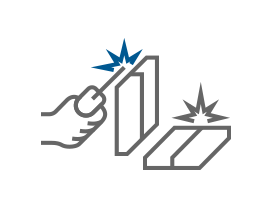
Welding
Completely remove rust, oil, moisture, paint, and any other substances that could adversely affect welding,
and select a welding rod appropriate for the steel grade being used.
For tack welding, use a shorter pitch than would be applied to carbon steel, and remove slag using a stainless steel wire brush.
After welding is complete, grinding and pickling are required to prevent local corrosion and loss of strength. -
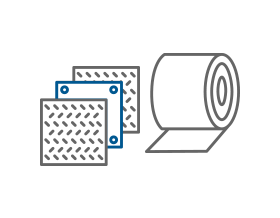
Installation and Installation Precautions
Stainless steel is shipped with a protective film to prevent scratches and contamination during installation;
however, be mindful of the film service life, as degradation over time and residual adhesive can cause problems;
clean the surface when removing the film after fabrication.
Use tools dedicated to stainless steel; if tools are shared with carbon steel, they must be thoroughly cleaned to remove iron particles before use.
Ensure that tile and stone cleaning agents, which are highly corrosive, do not come into contact with stainless steel surfaces;
if contact occurs, wash the surface immediately.
During construction site installation, protect surfaces from cement and dust, and wash down with neutral detergent and water after completion.
Chemically colored, etched, painted, or coated materials are especially susceptible to discoloration and surface damage, and repairs are difficult; the precautions described above should be observed with particular care for these materials.